Our website uses cookies to improve your experience and record usage statistics. By using our site you consent to cookies as described in our Privacy Policy. We take your privacy and data security very seriously and all information collected will be kept strictly confidential.
Home / blog / Single Phase vs. Three Phase Voltage Regulator
As a expert focused on selling Voltage Regulators, you need a blog that educates and guides businesses toward the right solution. This article on Single Phase vs. Three Phase Voltage Regulators is structured to highlight key comparisons, reinforce the importance of stable power, and gently introduce the reliability of NUOMAK products.
Choosing the correct Voltage Regulator is vital for protecting your valuable equipment and ensuring uninterrupted operations. This comprehensive guide will help you, our commercial and industrial clients, understand the fundamental differences between single-phase and three-phase solutions. We aim to equip you with the knowledge to make an informed investment that guarantees power stability for your specific business needs.
Before diving into the regulators themselves, you must distinguish between single-phase and three-phase power supply, as the regulator must match your input source.
Single-Phase Power: This system uses one alternating current (AC) flowing through a single conductor. It’s typically sufficient for lower power loads, smaller machinery, and general lighting found in small offices or residential setups. The voltage is often around 220V or 230V.
Three-Phase Power: This system utilizes three alternating currents, shifted by 120 degrees from each other. This setup delivers power more consistently and efficiently, making it the industry standard for large motors, heavy-duty machinery, data centers, and large-scale industrial plants. These systems typically operate at 380V or 400V and higher.
The type of machinery and total electrical load in your facility will immediately dictate the power system you use, and subsequently, the Voltage Regulator you need.
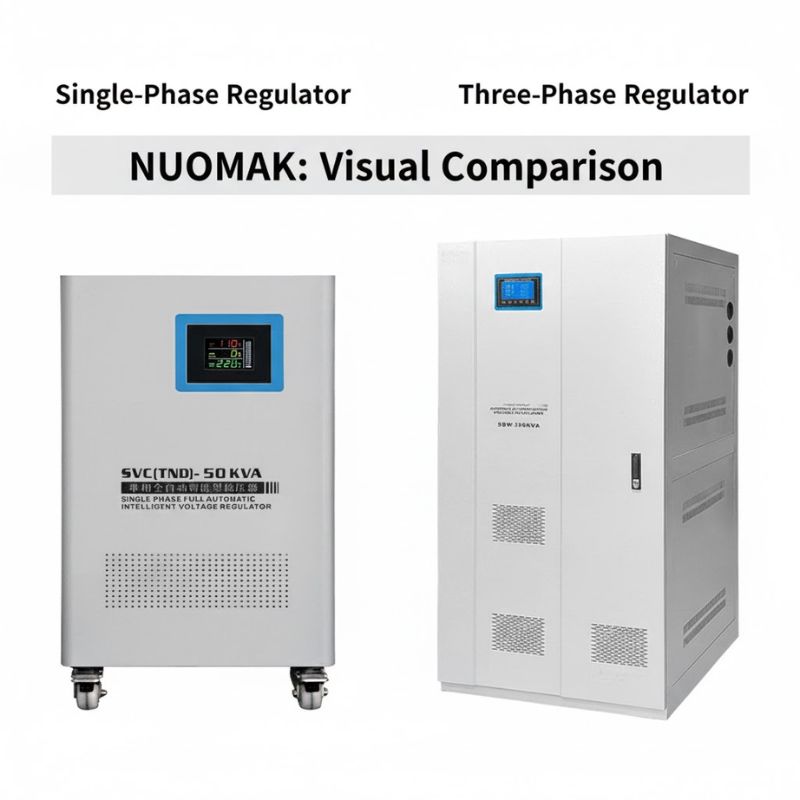
Single Phase vs. Three Phase Voltage Regulators: Key Differences
When evaluating the optimal Voltage Regulator for your operation, consider the following critical factors. The differences are significant and directly impact performance and cost-efficiency.
1. Power Capacity and Load Handling
Single-Phase Regulator: These are designed for light to moderate loads. They effectively stabilize voltage for smaller applications like computing equipment, small communication systems, and individual commercial air conditioning units. Their maximum power capacity is limited.
Three-Phase Regulator: These are built to manage massive electrical loads and high power requirements. They are the workhorses of industrial power, handling large-scale production lines, CNC machines, sophisticated medical equipment, and entire factory floors. If your operation depends on heavy-duty, high-power equipment, a three-phase regulator is non-negotiable.
2. Design and Complexity
Single-Phase Regulator: Featuring a simpler construction, typically involving a single transformer and control circuit, single-phase units are generally compact and easier to install. Maintenance is straightforward, and they are perfect for localized protection.
Three-Phase Regulator: These units are inherently more complex. They often use multiple transformers and a sophisticated integrated control system to simultaneously monitor and regulate all three phase lines. This complexity ensures optimal phase balance—a critical factor for three-phase motors—but requires more specialized installation and occasional maintenance.
3. Efficiency and Distribution
Single-Phase Regulator: While highly efficient for the loads they are designed to handle, they are less suitable for long-distance power distribution due to higher power losses compared to three-phase systems.
Three-Phase Regulator: These excel in overall system efficiency. By distributing the load across three phases, the current on each line is lower, leading to reduced energy losses and greater operational stability. This is particularly crucial for large commercial spaces and industrial plants where power is transmitted over significant distances.
4. Cost and Investment Value
Single-Phase Regulator: Due to their simpler design and smaller capacity, single-phase regulators have a lower initial purchase price. They are a cost-effective solution for smaller businesses or specific low-power departments within a larger company.
Three-Phase Regulator: The upfront cost for a three-phase unit is higher, reflecting the greater complexity, power handling, and advanced protective features. However, for industrial users, this investment delivers superior long-term value through increased equipment lifespan, higher efficiency, and crucial protection against phase imbalance, which can cause catastrophic equipment failure.
Summary of Differences
Feature
Single-Phase Voltage Regulator
Three-Phase Voltage Regulator
Ideal Application
Small offices, retail, small machinery, lighting.
Industrial manufacturing, data centers, large commercial buildings, heavy motors.
Power Capacity
Low to Moderate
High to Very High
Input Voltage
≈220V−240V
≈380V−415V or higher
Design
Simple, one transformer
Complex, three transformers or integrated control
Efficiency (Industrial)
Less efficient for heavy loads/distance
Highly efficient for large, balanced loads
Cost
Lower Initial Cost
Higher Initial Cost, but lower long-term risk
Making the Right Choice for Your Business
The decision is straightforward: You must select a Voltage Regulator that is engineered to handle the power supply and total load of your connected equipment.
If you run small to medium-sized commercial loads or are protecting a dedicated single-phase circuit within a larger facility: A Single-Phase Voltage Regulator will provide the stability you need at an efficient cost.
If your operation relies on three-phase motors, welding equipment, large HVAC systems, or mission-critical industrial machinery: A robust Three-Phase Voltage Regulator is essential. It prevents voltage imbalance, a common industrial power problem that severely damages three-phase equipment.
NUOMAK: Your Partner in Power Stability
At NUOMAK, we understand that power fluctuations translate directly into lost revenue and damaged assets for your business. Whether you require the focused protection of a single-phase unit or the heavy-duty reliability of a three-phase solution, our Voltage Regulator product line is built on precision engineering and guaranteed stability. Choose NUOMAK to secure your power, protect your investment, and keep your operations running smoothly.
FAQs
Can I use a single-phase regulator on a three-phase system?
No. A single-phase regulator is not designed to handle the voltage, current, or load balancing requirements of a three-phase system and attempting to do so will result in failure and potential equipment damage.
How do I know if my facility uses single-phase or three-phase power?
Check your main electrical panel or contact your facility manager or utility provider. Industrial and large commercial users almost exclusively use three-phase power for heavy machinery.
What is “voltage imbalance” and why is it dangerous in three-phase systems?
Voltage imbalance is when the voltage levels across the three phases are unequal. This is highly detrimental to three-phase motors, causing them to overheat, drawing excessive current, and significantly shortening their lifespan. A quality three-phase regulator is designed to prevent this.
Does a higher-capacity Voltage Regulator consume more energy?
No, a Voltage Regulator’s primary role is to stabilize voltage, not consume significant power. A well-designed unit, like those from NUOMAK, operates with very high efficiency, ensuring minimal energy loss during the voltage correction process.



 Optimized by Seraphinite Accelerator