
Io, Ir and Isd are markings associated with current ratings or protection settings on some MCCB trip units. Io may identify a coarse overload adjustment, Ir identifies the long-time overload pickup, and Isd identifies the short-time pickup in the electronic trip units discussed here. Their meanings, reference currents and available adjustments depend on the model.
If you are selecting a breaker for a panel or comparing a replacement, begin with the exact breaker and trip unit model. Send NUOMAK your model or purchase requirements to start a product inquiry.
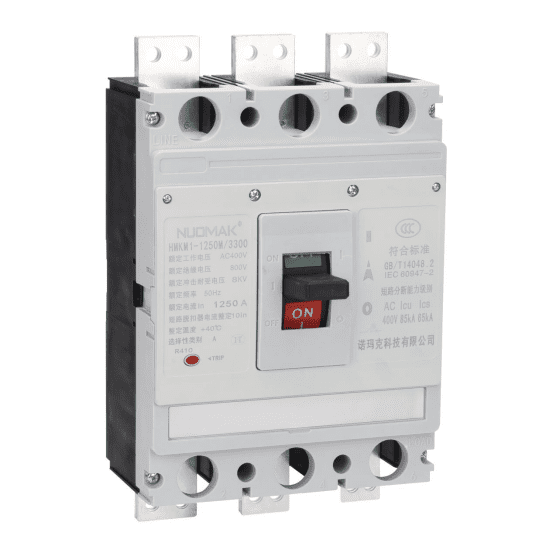
MCCB Trip Settings at a Glance
| Marking | What to check | Procurement relevance |
|---|---|---|
| In | Manufacturer-defined breaker, sensor or trip unit current rating | Confirm the rating of the quoted configuration. |
| Io | Coarse long-time pickup adjustment on certain models | Check whether this marking exists on your trip unit. |
| Ir | Long-time overload pickup | Verify the documented adjustment range and reference current. |
| Isd | Short-time pickup in the trip units discussed here | Check the short-time characteristic and associated delay. |
| Ii | Instantaneous pickup | Confirm whether it is fixed or adjustable. |
| tsd | Short-time delay | Check whether it is fixed or adjustable. |
These markings are a guide to reading documentation. They are not a universal set of controls fitted to every molded case circuit breaker.
What Is Io in an MCCB?
On certain Schneider Electric MicroLogic trip units, Io provides a coarse adjustment of the long-time pickup, followed by an Ir fine adjustment. This is a model-specific arrangement. Do not treat Io as a standard alternative name for rated current on every MCCB.
How Is Io Different from In?
In refers to the rated current defined for the device or configuration. Depending on the product, the manual may identify it as the breaker, sensor or rating plug current. Io, when provided, is an adjustment. Read both markings against the exact manual rather than interpreting them from the breaker frame size alone.
What Is Ir in an MCCB?
Ir is the long-time pickup associated with overload protection. The setting works with the long-time operating characteristic; exceeding the pickup does not mean the breaker necessarily opens immediately.
Its reference current and adjustment range vary. For sourcing, ask for the trip unit setting table instead of assuming that a range published for another series applies to the quoted breaker.
What Is Isd in an MCCB?
Isd identifies the short-time pickup in the electronic protection arrangements discussed here. It works with the short-time delay characteristic, commonly associated with tsd. The delay may support coordination with downstream protective devices, but successful coordination must be assessed for the installation.
Check the manual for the current used as the multiplier reference. A setting expressed relative to Ir cannot simply be read as the same multiple of In or Io.
How Is Isd Different from Ii?
Isd and Ii identify separate protection functions. Isd is associated with short-time protection; Ii is associated with instantaneous protection. Instantaneous operation has no intentional time delay, although the breaker still has a finite operating and clearing time. Fixed and adjustable options depend on the trip unit.
For a broader comparison of these functions and ground-fault protection, read our guide to LSIG protection in MCCBs.
What to Check Before Ordering an Adjustable MCCB
- Exact breaker and trip unit designation, including any configuration suffixes.
- Required current rating, operating voltage, frequency and number of poles.
- Required overload, short-time, instantaneous and ground-fault functions.
- Adjustment ranges and the current reference used for each setting.
- Icu and Ics ratings at the required operating voltage.
- Dimensions, mounting, terminals and required accessories.
Compare documented configurations rather than selecting a replacement by current rating or appearance alone. Final settings should follow the installation’s electrical design and protection assessment.
Explore MCCB Options for Your Purchase
Start with AC adjustable current MCCBs when your specification calls for adjustable protection. You can also review AC LCD adjustable current MCCBs when comparing display-equipped options. Confirm the actual functions of the quoted model; an LCD display does not establish which settings are available.
Have a Model Number or a Trip Unit Photo?
Send the information you have, together with your application and quantity if known. NUOMAK can coordinate with the supplying manufacturer to check product options and available model documentation. You do not need to identify every setting before starting a sourcing inquiry.
Frequently Asked Questions
Is Io the same as In?
Not necessarily. Io can identify a coarse adjustment on certain trip units, while In identifies a manufacturer-defined current rating. Check the exact model manual.
Does Isd mean instantaneous protection?
In the electronic trip units discussed here, Isd identifies short-time protection and Ii identifies instantaneous protection. Always confirm the manufacturer’s terminology for the specific device.
Can I copy settings from another MCCB?
Do not assume they are transferable. Different trip units can use different reference currents, ranges and time-current characteristics. The installation’s protection requirements must also be assessed.
Can I request a quote without knowing Io, Ir or Isd?
Yes. Provide the existing model, purchase specification or clear nameplate and trip unit photos if available. For a new order, share the required voltage, current, poles and quantity you know. Missing details can be identified during the sourcing discussion.
Discuss Your MCCB Purchase
For a project, distribution order or replacement inquiry, contact NUOMAK with your model information and required quantity. Ask for the proposed configuration and available documentation before ordering. Photos can also be shared through WhatsApp.
Request Product Options and a Quote
-
Reference: Schneider Electric MicroLogic technical documentation. Terminology and adjustment arrangements vary by model; verify the documentation for the exact product being supplied.