- Whatsapp: +8615825688470
- Email: [email protected]


In modern power distribution systems, reliability and automation are crucial. A single transient fault can trigger a power outage across a workshop, building, or industrial line—often requiring manual reset and causing costly downtime. To address this, the reclosing molded case circuit breaker (reclosing MCCB) has become a core device in smart grids, industrial power systems, and intelligent low-voltage distribution.
This article provides a comprehensive overview of what a recloser molded case circuit breaker is, including its operating principles, advantages, primary applications, and important considerations for selection.
A reclosing molded case circuit breaker is essentially:
Traditional MCCB + Intelligent Controller + Automatic Reclosing Mechanism
An MCCB protects electrical systems from overload, short circuits, and abnormal conditions. Once tripped, it normally requires manual on-site reset.
This is the “smart” part. After a trip, the intelligent controller analyzes the fault. If the fault is judged to be transient (for example, lightning interference, temporary contact with animals, or momentary insulation breakdown), the MCCB will automatically reclose according to preset logic to restore power.
In short, a reclosing MCCB is not only a protective device but also an intelligent terminal capable of fault analysis, autonomous decision-making, and rapid power restoration.
Studies show that approximately 80% of distribution network faults are transient. Traditional MCCBs disconnect the circuit but require technicians to manually reclose—causing delays and productivity loss.
A reclosing MCCB offers three major advantages:
Transient faults can clear within seconds. Automatic reclosing restores power almost instantly, reducing downtime from hours to seconds.
This is essential for:
automated factories
hospitals
data centers
commercial complexes
In remote substations, distributed solar power stations, mines, and agricultural areas, dispatching personnel to manually reset a breaker is costly.
Reclosing MCCBs support remote control, remote monitoring, and real-time communication, enabling truly unmanned operation and maintenance.
A few seconds of power interruption can cause lost batches of products, damaged equipment, data loss, or customer impact. Automatic reclosing helps maintain continuous operation and minimizes unexpected downtime.
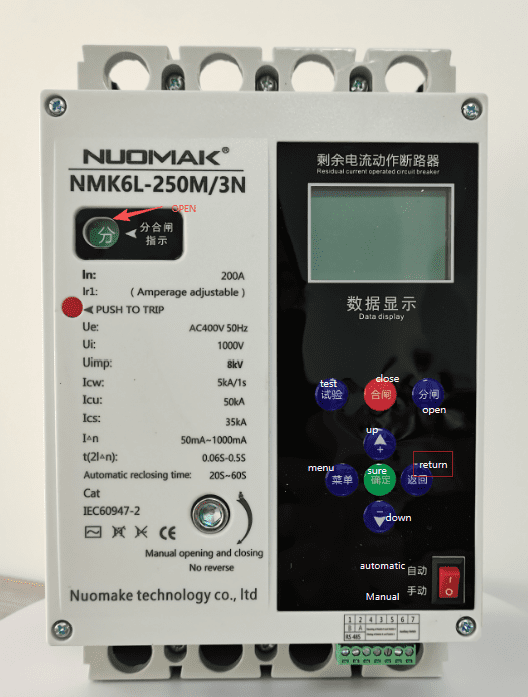
A reclosing MCCB follows a structured protection and reclosing sequence.
When a fault occurs, the MCCB detects abnormal current and trips immediately to protect the system.
The intelligent controller analyzes parameters such as:
fault current
duration
waveform characteristics
Using predefined thresholds, it determines whether the fault is transient or permanent.
If the fault is transient, the controller waits for a preset time (often 10–30 seconds) to allow insulation recovery or de-ionization.
After the delay, the controller commands the internal mechanism to reclose the MCCB.
Successful Reclosing
If current and voltage return to normal, power is restored and monitoring continues.
Failed Reclosing
If the fault persists, the breaker trips again immediately.
The controller typically allows 1–3 reclosing attempts.
After repeated failures, it classifies the fault as permanent and locks the system in the open position.
This prevents repeated impact and protects equipment until maintenance personnel intervene.
Used as key protection and switching devices in 0.4–10 kV distribution systems.
Common in mining, petroleum facilities, port terminals, railway traction stations, wind farms, and solar PV stations.
Suitable for critical loads such as:
data centers
hospitals
airports
large commercial complexes
Ideal for long-distance irrigation lines, rural power systems, and remote distributed applications where manual closing is difficult.
Modern devices often include:
RS485
Ethernet
Modbus
wireless communication
These enable remote measurement, signaling, control, and parameter adjustment.
Key settings include:
number of reclosing attempts
reclosing delay
fault current thresholds
operation logic coordination
Proper configuration ensures selective coordination with other protection devices.
The reclosing function operates only for fault clearing.
Before maintenance, the circuit must always be isolated and grounded to prevent unintended reclosing.
A recloser is typically used for medium-voltage systems (e.g., 10–33 kV), whereas a reclosing MCCB is used for low-voltage distribution.
Usually 1–3 times, depending on system coordination requirements.
Yes. It is widely used in low-voltage PV collection circuits to improve system reliability.
No—provided proper lockout/tagout (LOTO) procedures are followed. Reclosing protection works only during faults and must be disabled during maintenance.
Modbus-RTU over RS485 is most common. Some models also support Ethernet TCP/IP, wireless, or IoT protocols.
The reclosing molded case circuit breaker represents a major step forward from traditional passive protection to intelligent, automated, active recovery in low-voltage distribution. With the ability to analyze faults, perform autonomous reclosing, and drastically reduce power outage time, it is an essential component of modern industrial facilities, smart grids, and unmanned electrical systems.
For businesses and power system designers seeking higher reliability, reduced downtime, and automated protection, a correctly selected reclosing MCCB is a smart and future-ready investment.

WEBSITE&YUEQING NUOMAKE TECHNOLOGY CO.,LTD.
Privacy Policy | SiteMap
Copyright NUOMAK
 Optimized by Seraphinite Accelerator