- Whatsapp: +8615825688470
- Email: [email protected]


Choosing the right circuit breaker is essential for ensuring electrical safety and system reliability. Although AC MCCBs and DC MCCBs look similar in appearance, their internal structure, arc-extinguishing methods, and application scenarios are very different. Using the wrong type can result in severe electrical hazards.
This guide explains the key differences between AC and DC MCCBs, how they work, and how to choose the correct one for your application.
| Feature | AC MCCB | DC MCCB |
|---|---|---|
| Current Characteristics | Alternating current with periodic zero-crossing | Continuous current with no zero-crossing |
| Arc Extinguishing Difficulty | Easier due to natural zero-crossing | Difficult; arc burns continuously |
| Primary Arc-Extinguishing Method | Standard arc chamber | Magnetic blowout arc-extinguishing technology |
| Pole Configuration | Single pole or multi-pole | Often multiple poles in series to increase breakpoints |
| Wiring Polarity | No strict polarity | Polarity-sensitive (positive and negative must be followed) |
| Common Applications | Building and industrial AC distribution | PV systems, battery banks, EV charging, rail transit, telecom DC systems |
In AC systems (50Hz or 60Hz), the current crosses zero many times per second. When a circuit breaker opens, the arc weakens naturally at the zero-current point, making it easier to extinguish.
For this reason:
AC MCCBs use simpler arc-extinguishing structures
The design relies partly on the natural behavior of alternating current
DC has no zero-crossing and flows continuously. When a breaker attempts to interrupt the circuit:
The arc burns steadily
Temperature rises rapidly
The arc will not extinguish naturally
To overcome this, DC MCCBs use magnetic blowout technology, which:
Creates a strong magnetic field
Forces the arc into the arc chute
Stretches, cools, and splits the arc until it is extinguished
This is why DC MCCBs are more complex and often have more breakpoints.

Doing so can lead to:
Inability to interrupt fault current
Persistent arc burning
High temperature rise
Fire or explosion
Severe equipment damage and safety risks
The underlying reason is simple:
AC MCCBs cannot extinguish the continuous arc produced by direct current.
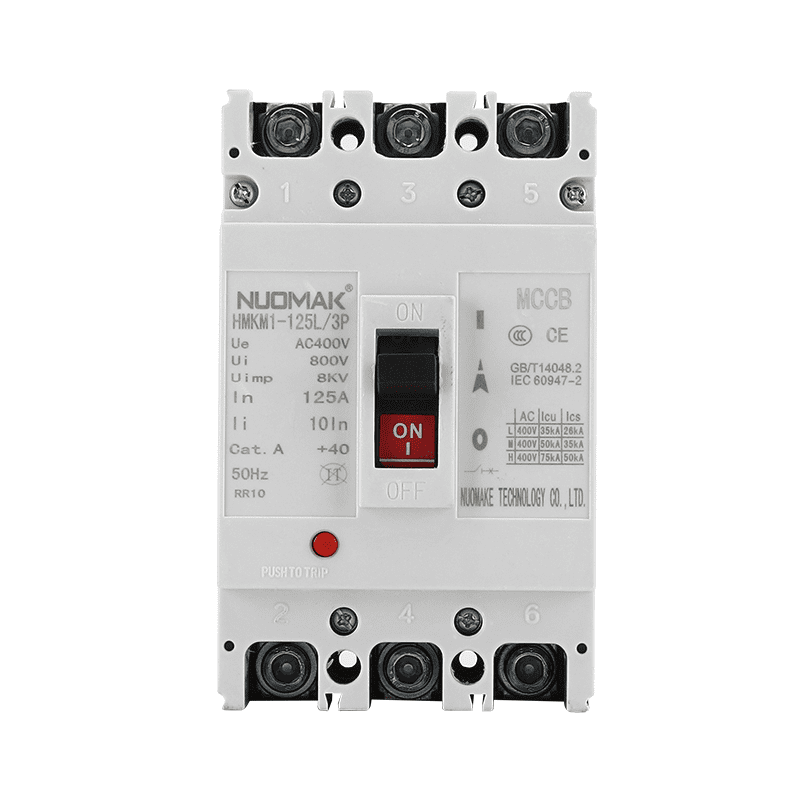
Building distribution boards
Industrial AC power systems
Motor loads and HVAC equipment
General electrical distribution
Solar photovoltaic (PV) arrays
Battery energy storage systems
Electric vehicle charging stations
Uninterruptible power supply (UPS) systems
Rail transit and metro
Telecom and data center DC power systems
Any system powered by direct current requires a DC-rated MCCB to safely interrupt fault currents.
Confirm the following information:
AC or DC rating
Voltage level (e.g., DC 250V, DC 500V, AC 400V)
Breaking capacity (kA)
Pole configuration
For solar, battery, EV, and other DC applications → Use a DC MCCB
For building and industrial AC distribution → Use an AC MCCB
Incorrect MCCB selection may lead to safety risks. If you’re unsure, consult an electrical engineer or a qualified equipment supplier.
The difference between AC and DC MCCBs goes far beyond their appearance. Their arc-extinguishing mechanisms, polarity requirements, and application scenarios are fundamentally different. Choosing the correct type ensures reliable operation and prevents severe electrical accidents.
Just remember the essential rule:
Use AC MCCBs for AC systems and DC MCCBs for DC systems — never interchange them.

WEBSITE&YUEQING NUOMAKE TECHNOLOGY CO.,LTD.
Privacy Policy | SiteMap
Copyright NUOMAK
 Optimized by Seraphinite Accelerator