- Whatsapp: +8615825688470
- Email: [email protected]


Voltage regulators are essential components in modern electronics, helping to maintain a stable and consistent output voltage regardless of changes in input voltage or load conditions. Whether you’re designing power supplies, embedded systems, or large industrial equipment, selecting the right type of voltage regulator is critical to ensuring safety, efficiency, and performance.
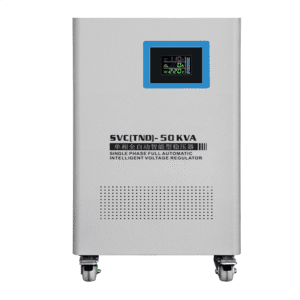
In this blog, we’ll introduce 6 important types of voltage regulators you should know—ranging from simple components like Zener diodes to advanced systems like switching regulators and constant voltage transformers.
| Voltage Regulator Type | Key Features | Common Applications | Limitations |
|---|---|---|---|
| Linear Voltage Regulator | Simple, low noise, clean output | Consumer electronics, sensors, audio circuits | Low efficiency, heat dissipation |
| Low Dropout Regulator (LDO) | Works with small input-output voltage difference, efficient, compact | Mobile phones, laptops, IoT devices | Limited output current, still less efficient |
| Switching Regulator | High efficiency, handles high power, supports step-up/down | Power supplies, industrial, automotive | EMI issues, needs filters |
| Electromechanical Regulator | Durable, handles large voltage swings | Generators, alternators, old equipment | Slow, less precise, outdated technology |
| Zener Diode Regulator | Very simple, low-cost, compact | Signal conditioning, reference voltage | Not for high current, poor precision |
| Constant Voltage Transformer (CVT) | Stable output, isolates, handles spikes | Medical, telecom, critical machines | Bulky, low efficiency |
Linear voltage regulators are one of the most commonly used types due to their simplicity and low noise output. They work by using an active pass element (such as a transistor) to drop the input voltage to a desired lower level.
Simple to use
Provide clean, ripple-free output
Ideal for low-power applications
Consumer electronics, sensors, audio circuits
Note: Linear regulators are not energy efficient, especially when the voltage difference between input and output is large—they dissipate the excess power as heat.
A Low Dropout Regulator (LDO) is a special kind of linear regulator that can operate with a very small difference between input and output voltage. This makes LDOs ideal for battery-powered and portable devices where efficiency matters.
Requires less voltage headroom
Smaller form factor
Lower power loss compared to standard linear regulators
Mobile phones, laptops, wearables, IoT devices
Tip: Always check the dropout voltage in the datasheet when selecting an LDO for your circuit.
Switching regulators use high-speed switching components (typically transistors and inductors) to convert and regulate voltages efficiently. Unlike linear regulators, they don’t waste excess voltage as heat, which makes them highly efficient—often above 85%.
Buck Converter (step-down)
Boost Converter (step-up)
Buck-Boost Converter (step-up/down)
High efficiency
Suitable for high-power applications
May generate EMI and require additional filtering
Power supplies, industrial electronics, automotive systems
These are older types of regulators that use mechanical components like relays, solenoids, or electromechanical sensors to maintain a constant voltage. Though largely replaced by modern solid-state designs, electromechanical regulators are still found in some heavy-duty systems and older vehicles.
Rugged and durable
Can handle large voltage fluctuations
Slower response time
Generators, alternators, vintage equipment
Note: They are less precise and efficient compared to electronic regulators.
A Zener diode is a simple and cost-effective way to create a basic voltage regulator. When reverse-biased beyond its breakdown voltage, the Zener diode maintains a nearly constant voltage across its terminals.
Very simple circuit
Good for low-current, fixed-voltage applications
Inexpensive and compact
Reference voltage sources, signal conditioning, protection circuits
Limitation: Zener regulators are not suitable for high current or precision voltage regulation.
Constant voltage transformers use resonant magnetic principles to regulate voltage. They are most effective for maintaining a constant output in environments with fluctuating or unstable input voltage.
Excellent output voltage stability
Electrical isolation
Withstands spikes and surges
Medical equipment, telecom systems, critical industrial machinery
Downside: They are bulky and less energy efficient compared to modern switching regulators.
Understanding the different types of voltage regulators—and when to use each—can make a significant impact on your system’s performance, safety, and energy efficiency. From low-noise linear regulators to robust switching converters and constant voltage transformers, each type offers unique advantages tailored to specific use cases.

WEBSITE&YUEQING NUOMAKE TECHNOLOGY CO.,LTD.
Privacy Policy | SiteMap
Copyright NUOMAK
 Optimized by Seraphinite Accelerator